
GFRP Rebar
Replace traditional TMT steel with NEOBARS™ Glass Fiber Reinforced Polymer (GFRP) rebars. Up to 75% lighter, 2x stronger, and engineered for a 100+ year service life with zero rust.
100% Non-Corrosive & Rust-Proof
Tensile Strength Over 1,000 MPa
Certified to ISO 9001:2015 & IS 18256:2023
Pan-India & International Delivery




What is GFRP Rebar?
GFRP (Glass Fiber Reinforced Polymer) rebar is an advanced structural composite reinforcement manufactured through a continuous pultrusion process. High-strength continuous E-CR or basalt glass filaments are saturated with premium polymer resin (such as vinyl ester or epoxy) and pulled through a heated die to form solid, rigid reinforcement bars.
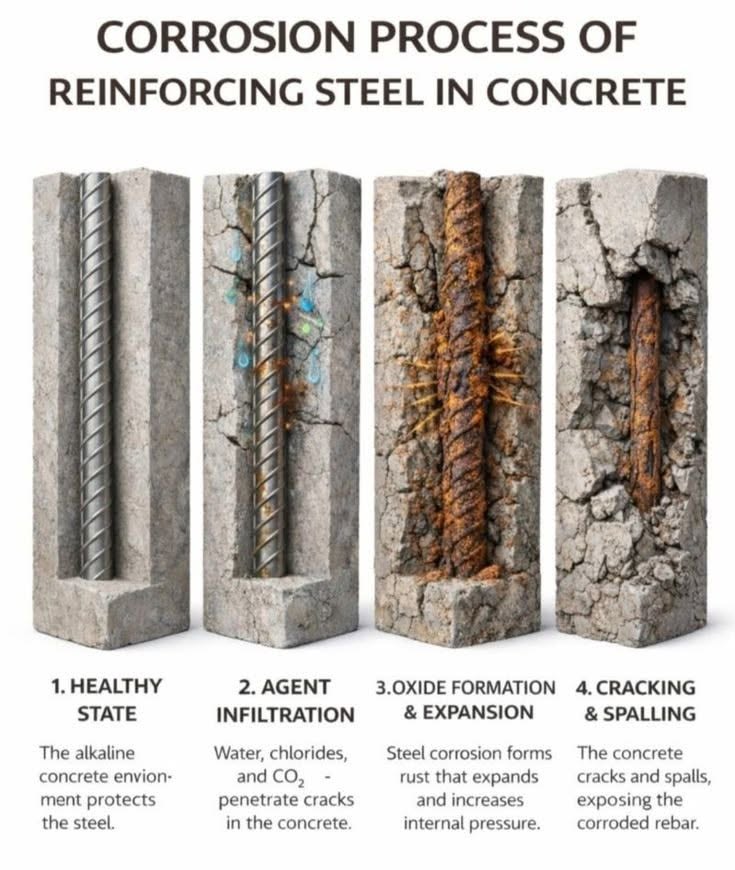
To ensure optimal bonding within concrete structures, NEOBARS™ GFRP rebars feature textured spiral ribs and an integrated sand-coated surface. This mechanically locks the rebar into the surrounding concrete matrix, matching or exceeding the pull-out bond strength of deformed steel bars. GFRP rebar was engineered specifically to solve the single greatest structural vulnerability of standard reinforced concrete: rebar corrosion and concrete spalling.
Key Benefits of GFRP Rebar
- 100% Corrosion & Salt Resistance: Completely impervious to chloride attack, saline ocean air, aggressive groundwater, and chemical exposure. It will never oxidize, rust, or cause concrete cracking.
- Exceptional Tensile Strength: Reaches tensile strengths exceeding 1,000 MPa—more than double that of conventional structural steel (Fe 500/550).
- Substantial Weight Reduction: Weighing roughly one-fourth (25%) of equivalent steel bars, it simplifies freight logistics, eliminates the need for site cranes during placement, and lowers worker fatigue and injury risks.
- Electromagnetic & Thermal Neutrality: Completely non-magnetic and electrically non-conductive. Ideal for medical imaging suites (MRI rooms), airport radar towers, rail transit power zones, and high-voltage substations.
- Structural Longevity & Zero Maintenance: Designed for an intended design life spanning 100+ years without requiring costly cathodic protection, epoxy touch-ups, or recurring repair cycles.
Why Choose GFRP Rebar for Your Next Project?
Switching from conventional steel to NEOBARS™ GFRP rebars delivers critical economic and engineering advantages:
- Lower Total Cost of Ownership (TCO): While initial material expenses may appear competitive with treated steel, the elimination of heavy lifting equipment, lower freight bills, and zero structural maintenance deliver substantial net savings over the project lifecycle.
- Precision Factory Bends (Neobends): Unlike steel, composite rebars cannot be bent on-site after curing. NEOBARS™ by Dura Composites solves this challenge with pre-engineered, factory-cured bent profiles, stirrups, rings, and dowels tailored to exact structural drawings.
- Sustainable Infrastructure: The manufacturing and transport lifecycle of GFRP generates significantly lower greenhouse gas emissions compared to traditional coal-fired iron smelting and steel rolling.
Technical Comparison for GFRP Rebar
Parameter |
NEOBARS™ - GFRP Rebar |
Traditional Steel TMT Bar (Fe 500/550) |
|---|---|---|
Corrosion Resistance
|
100% Rust-Proof (Immune to chlorides & chemicals)
|
High risk of oxidation, rust, and spalling
|
Tensile Strength
|
> 1,000 MPa (Double the strength)
|
~ 500 – 550 MPa
|
Density / Weight
|
~ 2.1 g/cm³ (75% lighter than steel)
|
~ 7.85 g/cm³ (Heavy manual handling)
|
Electrical & Magnetic Conductivity
|
Non-conductive, non-magnetic
|
Highly conductive & magnetic
|
Design Life Expectancy
|
100+ years in aggressive environments
|
25 – 40 years (Accelerated decay in marine/saline soil)
|
On-Site Bending
|
Factory pre-formed to specifications (Neobends)
|
Bent on-site manually or with bar benders
|
Applications Across Modern Infrastructure
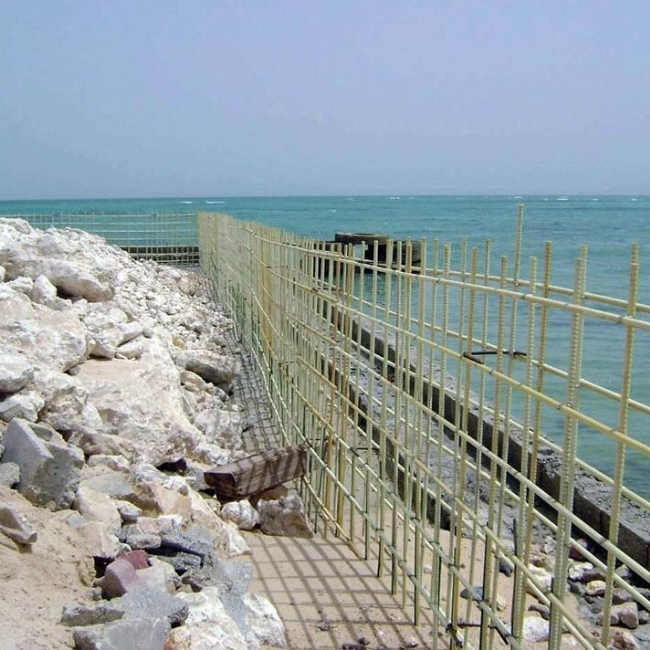
Marine & Coastal Works
Seawalls, jetties, dry docks, coastal flood barriers, and bridge abutments subjected to continuous saltwater exposure.
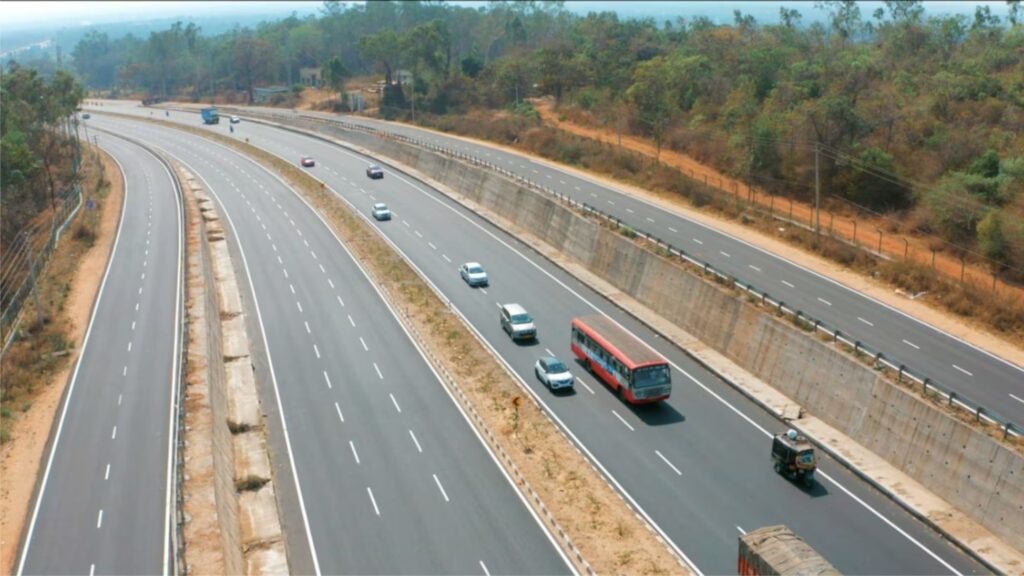
Roads, Highways & Bridges
Bridge deck slabs, approach pavements, sound barriers, and median dividers exposed to heavy vehicular wear and de-icing chemicals.
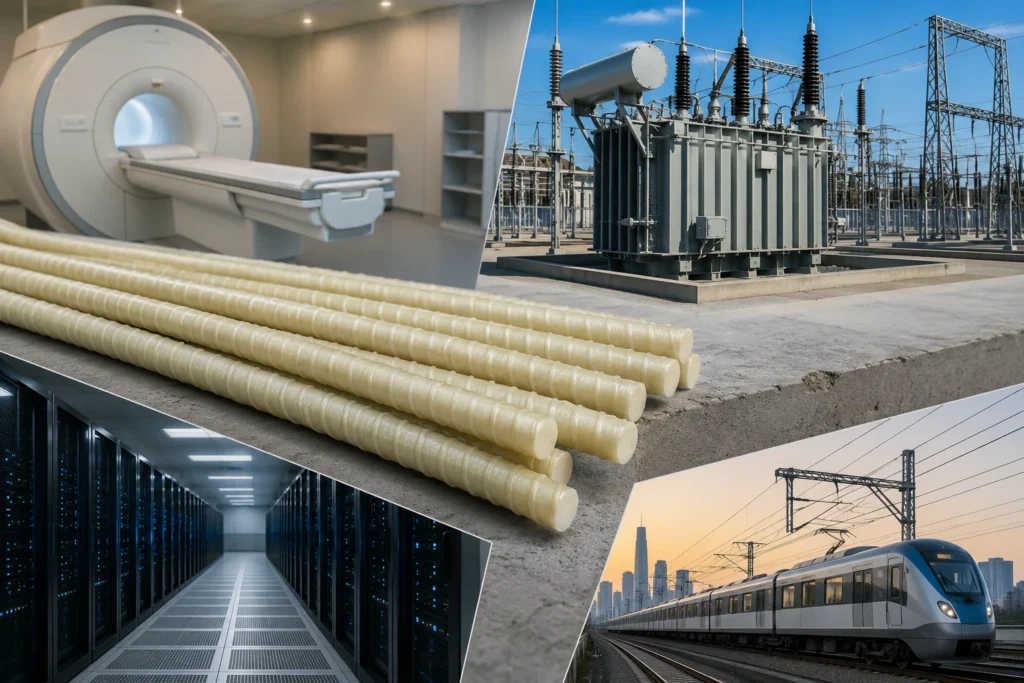
Electromagnetically Sensitive Facilities
MRI scanner rooms in hospitals, airport runway navigation stations, data center basements, and high-voltage transformer substations.
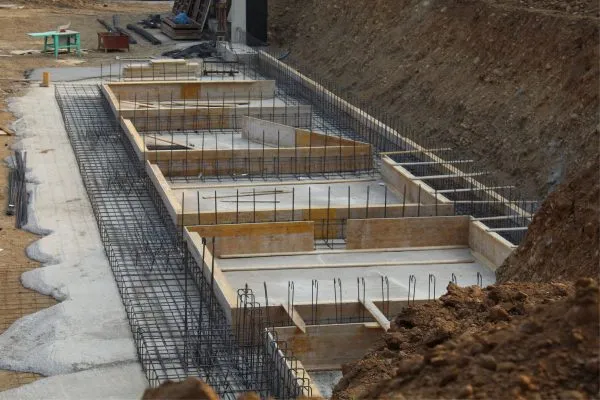
Industrial & Water Treatment Infrastructure
Wastewater treatment tanks, chemical containment sumps, cooling towers, and mining ventilation shafts.
What Our Clients Say
Dura Composites’s commitment to quality and prompt service has ensured seamless execution, making them our go-to choice for reliable solutions. Their ability to customize products to meet our project needs has contributed to our overall efficiency. We highly recommend their solutions for infrastructure projects requiring durability and precision.
Dura Composites’s products are incredibly easy to use and install. The fast installation process has helped us meet project deadlines efficiently, reducing both time and labour costs significantly. The durability and long-term performance of their products have also minimized maintenance efforts, ensuring hassle-free operations for our projects.
Dura Composites has been a game-changer for us. The cost savings and ease of use have made our residential construction more efficient, without compromising on quality. The lightweight yet robust materials have simplified our installation process while enhancing the structural integrity of our homes, making them a smart investment for long-term sustainability.
We used Dura Composites’s NEO-BENDS for NHAI drainage structures, and the design accuracy, fast installation, and major cost savings made a significant impact on our project! The durability of their products ensures long-term performance, reducing the need for frequent maintenance. We are confident that their innovative solutions will continue to add value to large-scale infrastructure projects.
Frequently Ask Questions (F&Q)
Yes, GFRP rebars (Glass Fiber Reinforced Polymer bars) are formally standardized for structural concrete in India under BIS standard IS 18256:2023 and highway/bridge guidelines IRC:137-2022. Internationally, structural design and material qualification follow ACI 440.1R (American Concrete Institute) and ASTM D7957. At Dura Composites, every production lot undergoes third-party NABL-accredited testing for guaranteed tensile strength, transverse shear, moisture absorption, and alkaline resistance to meet PWD, NHAI, and CPWD tender specifications.
GFRP rebar offers more than double the tensile strength of Fe 500/550 TMT steel (>1,000 MPa vs. 500-550 MPa) at one-fourth the weight (~2.1 g/cm³ vs. 7.85 g/cm³), while remaining 100% immune to electrochemical corrosion. However, because GFRP exhibits linear-elastic behavior up to failure (unlike steel’s ductile yield plateau) and has a lower modulus of elasticity (~45-60 GPa vs. 200 GPa for steel), structural engineers design GFRP-reinforced concrete using limit-state serviceability and deflection checks per IS 18256:2023 rather than a 1:1 diameter swap in load-bearing beams.
We manufactures NEOBARS™ GFRP rebars in standard diameters of 6mm, 8mm, 10mm, 12mm, 16mm, 20mm, 25mm, and 32mm. Standard straight bars are supplied in 6-meter and 12-meter lengths (or custom container lengths up to 11.8 meters for export), alongside continuous coils for 6mm-10mm sizes, factory-cured GFRP bent bars (stirrups/ties), and smooth GFRP dowel bars for rigid concrete pavements.
On a per-meter basis, GFRP bars are competitively priced against corrosion-resistant steels like Epoxy-Coated (FBEC) or Stainless Steel rebars, and typically deliver 15% to 30% lower Total Cost of Ownership (TCO) than standard TMT bars. While raw material cost per meter can be slightly higher than basic Fe 500 TMT in non-corrosive zones, projects save immediately on freight (up to 4x more running meters per truckload), zero craneage for manual cage placement, faster tying speed, and complete elimination of concrete spalling repairs over a 100-year service life.
No, thermoset GFRP bars cannot be bent on-site after pultrusion curing because heating or cold-bending damages the polymer matrix and fractures glass fibers. All stirrups, U-bars, L-bends, and custom geometries must be factory-preformed during resin curing such as NEOBENDS™ by Dura Composites. Straight GFRP bars can, however, be easily cut on-site to exact lengths using a standard handheld diamond-blade angle grinder or masonry saw without generating sparks.
High-grade GFRP rebars manufactured with corrosion-resistant E-CR glass fibers and vinyl ester resin resist alkaline pore-water degradation for 100+ years. Inferior bars made with standard E-glass and polyester resin can suffer alkali-silica reaction inside wet concrete (pH 12.5–13.5). DuraNeo uses alkali-resistant E-CR glass filaments saturated with premium vinyl ester resin, verified through accelerated alkaline conditioning tests under ASTM D7957 and IS 18256:2023.
Embedded inside standard concrete cover (typically 30-50 mm), GFRP rebar maintains structural integrity during building fires because concrete acts as an effective thermal insulator. While exposed GFRP resin begins softening near its glass transition temperature ($T_g \approx 100^\circ\text{C}\text{–}120^\circ\text{C}$), continuous glass filaments retain tensile capacity up to $500^\circ\text{C}+$, and the surrounding concrete prevents oxygen access. Additionally, GFRP’s thermal expansion coefficient closely matches concrete, preventing thermal micro-cracking.
GFRP bars are tied using heavy-duty UV-stabilized nylon zip ties or PVC-coated tie wire, and lap-spliced using standard overlapping lengths specified by the structural consultant (typically $40d$ to $50d$ depending on concrete grade). Unlike steel, GFRP bars require no rust-prevention oil or tarpaulin rust-shielding, though prolonged direct UV exposure over several months before pouring should be minimized by storing bundles under basic shade or breathable covers on wooden battens.
GFRP bars deliver the highest engineering and financial ROI in chloride-rich, chemically aggressive, or electromagnetically sensitive environments. Key applications include coastal seawalls, jetties, bridge decks, NHAI highway pavements (using GFRP dowel bars), sewage and effluent treatment plants (STP/ETP), chemical plants, hospital MRI rooms, metro rail stray-current zones, and high-voltage substation foundations.
Ready to Build Rust-Free, Future-Proof Concrete Structures?
Contact Engineering Support / Request Quote
+91 7038850006
+91 9270213006
+91 9699913006
Plot no. D-2, At. Balgaon, Mohapa Road, MIDC Industrial Area, Umred, Nagpur, Maharashtra-441203
ritik@duraneo.com
sumit@duraneo.com