
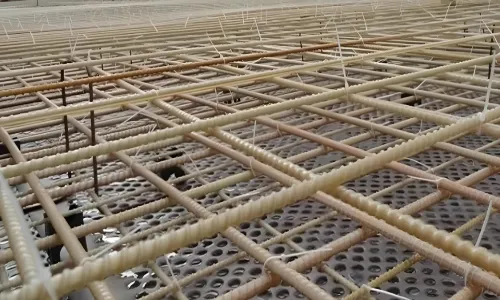
In construction, delays rarely come from one big mistake. They are usually a result of small mistakes that are ignored over time. Right from waiting on materials to be moved, fixing damaged coatings, coordinating additional waterproofing, or dealing with corrosion far earlier than planned. Steel rebar has been the industry standard for decades, but as project timelines get tighter and margins slimmer, its limitations are becoming harder to ignore. This is where Fiber Reinforced Polymer (FRP) rebar, commonly referred to as composite rebar, is transforming the industry.
Why Composite Rebars Reduce Construction Delays and Rework!
Lightweight Materials That Speed Up Installation
One of the first differences noticed on site is weight. Steel rebars are heavy, difficult to maneuver, and often require cranes or multiple workers just to move them into position. Composite rebars are significantly lighter, roughly one-fourth the weight of steel.
Because they are easier to carry and place, reinforcement grids can be installed faster, with less physical strain on crews and less dependence on lifting equipment. This keeps work moving steadily and allows teams to reach the concreting stage sooner.
Eliminating Corrosion Removes a Major Cause of Delays
Corrosion is one of the biggest reasons reinforced concrete structures need repair. As steel rusts, it expands, cracks the surrounding concrete, and eventually leads to spalling and structural deterioration. Composite rebars eliminate this issue entirely.
Made from glass, basalt, or carbon fibers bound in resin, they do not react with water, salts, or harsh chemicals. As a result, many of the time-consuming preventive steps associated with steel, such as protective coatings or extensive waterproofing, can often be reduced or avoided altogether. This not only shortens construction timelines but also significantly lowers the risk of future rework.
Designed for Real Job-Site Conditions
Construction sites are rarely gentle environments. Materials are dragged, dropped, exposed to weather, and handled repeatedly by different teams. With steel rebar, especially epoxy-coated variants, this can create problems. Even minor coating damage can compromise corrosion protection, forcing teams to stop work and carry out repairs before pouring concrete. Composite rebars, on the other hand, are far more resilient. Their performance does not depend on surface coatings, and rough handling does not affect their structural integrity. This reduces inspections, eliminates touch-up work, and helps reinforcement stages progress without unnecessary stoppages.
Faster Progress Through Simpler Logistics and Safer Handling
Delays don’t only happen on-site. They often start with logistics and safety approvals. Because composite rebars are lighter, more material can be transported in a single truckload, reducing delivery frequency and coordination challenges. On-site, they can typically be cut using standard tools without sparks or flames, avoiding hot-work permits and related safety delays. These small efficiencies add up, especially on large or time-sensitive projects.
Where the Time Savings Really Add Up
When viewed together, these differences have a direct impact on project timelines. Steel rebar slows installation due to its weight and reliance on cranes, while composite rebar allows faster, manual placement. Steel’s vulnerability to corrosion adds preventive steps during construction and increases the likelihood of repairs later, whereas composite rebar removes this risk entirely.
On-site, steel often requires careful handling and frequent touch-ups, while composite rebar remains unaffected by rough conditions. Even logistics play a role. Steel limits how much material can be transported per delivery, while composite rebar allows higher volumes per truck, reducing coordination delays. Over the life of a structure, this results in more maintenance and rework with steel, and far fewer interruptions when composites are used.
Choosing composite rebar isn’t simply about adopting a new material but about removing friction from the construction process. By eliminating corrosion risk, reducing handling complexity, and simplifying logistics, composite rebars help projects stay on schedule today while minimizing costly interventions in the future.