
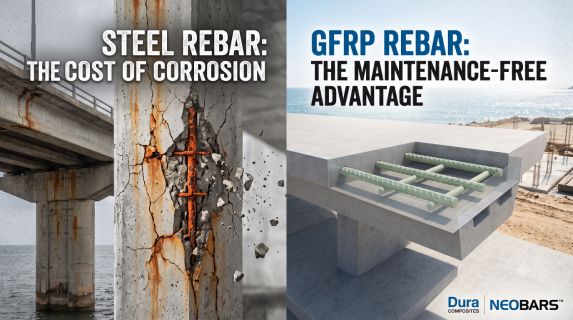
FRP rebar helps reduce maintenance costs by eliminating corrosion, the leading cause of deterioration in reinforced concrete structures. It also costs less and offers a longer service life, especially in corrosive environments.
What the infrastructure industry tends to overlook is the fact that steel not only takes a relatively higher upfront cost but also a higher maintenance cost, hidden in every infrastructure budget. Once you factor in that cost, repairs, and downtime that follow for decades, steel becomes an unfavourable choice. FRP such as NEOBARS(TM) by Dura Composites flip that equation entirely. They aren’t only priced lower than steel to begin with, but also, they are backed by far lower maintenance costs across labour, efficiency, and repairs over the life of the structure. Let’s explore this further below.
Corroded Steel Rebar Cracking Concrete VS Rust-free FRP Rebar
1. Corrosion Is the Real Maintenance Bill
Corrosion costs the world about $2.5 trillion a year, roughly 3.4% of global GDP. In the US alone, it’s $276–450 billion annually. The important part is that a decent load of this could be avoided entirely by choosing the right material at the design stage.
When steel rebar corrodes, the rust can expand up to six times in volume, cracking and breaking apart the concrete around it. Naturally, this is also a common cause of early failure in concrete structures worldwide. And once that cycle starts, repair becomes necessary. Steel also needs a thick layer of concrete cover (40–75 mm) just to slow down moisture and chloride reaching the bar. This means extra material cost from day one, purely to manage a risk FRP doesn’t have in the first place.
2. How FRP Breaks the Cycle
FRP rebar doesn’t just slow corrosion down; it removes it completely:
It never rusts. No steel means no reaction to chlorides, no corrosion, no damage from acidic or alkaline exposure. The whole maintenance cycle never even begins.
It also lasts much longer. While steel structures in corrosive environments often need major repair within 40-50 years, FRP structures are being designed, and in some cases already proven, to last 100+ years with very little upkeep.
It’s cheaper over time. Looking at costs over 50 years, FRP consistently comes out 30-50% cheaper than steel in corrosive settings, and up to 60-80% cheaper in the harshest conditions, like bridge decks exposed to de-icing salt or marine structures. In some cold-climate cases, the extra upfront cost pays for itself in under three years. It is also easier to handle. FRP is about 75% lighter than steel, so it’s easier to transport and install, preventing damage from rough handling as well.
FRP performs the best in:
- Marine structures and waterfronts
- Bridge decks and highways in de-icing salt regions
- Water and wastewater treatment plants
- Parking structures with salt runoff
- Tunnels and underground structures
In conclusion, choosing a FRP rebar makes a big difference in a structure’s maintenance cost. Steel guarantees a recurring repair bill wherever there’s moisture or chloride exposure. FRP largely removes that bill, especially for a project built to last decades in a corrosive environment.