
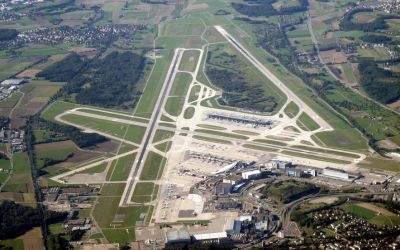
It’s common knowledge that airports demand pavement materials that stand up to heavy, repetitive loads, de-icing chemicals, jet fuel spills, and decades of service with minimal closures. Lately, composite reinforcing bars such as glass-fiber-reinforced polymer (GFRP) rebars are becoming a more accepted alternative to steel for the same. Not only is it well-suited to airfield pavements but also is more durable. Below, we dive deeper into the same.
Why Composite Rebar is Conducive For Runways
Corrosion resistance: longer service life and fewer closures
Steel reinforcement corrodes when chlorides (from de-icing salts, marine air, or runway maintenance) reach it. This leads to concrete spalling and repairs that close pavement lanes. GFRP, on the other hand, does not corrode, so initial and recurring repair cycles are greatly reduced. This is a major advantage for runways where closures disrupt operations and are costly.
Improved life-cycle economics in corrosive environments
The initial material cost for FRP rebar is significantly lower than ordinary steel. Moreover, life-cycle studies show GFRP-reinforced concrete can be economically favourable because of much lower maintenance and longer service life as well. Recent comparative life-cycle assessments (LCA) and LCC studies also report lower greenhouse-gas footprints and meaningful whole-life cost advantages for GFRP rebar in the right exposure conditions.
High strength-to-weight and easier handling on site
GFRP rebars are lighter than steel (easier to lift and position), do not require welding or bonding for electrical continuity, and eliminate the safety hazards associated with rusted steel. This can speed placement and reduce labour costs, bringing multiple advantages.
Non-conductive / electromagnetic transparency
FRP is electrically non-conductive and non-magnetic. That can be beneficial near sensitive navigational or communications equipment. Furthermore, it also eliminates stray current corrosion issues, an issue with steel in electrified areas.
Fatigue and impact performance (context-dependent)
Some studies show FRP-reinforced concrete performs well under cyclic impact and fatigue when designed correctly, which is important for runways subjected to repeated wheel loads and occasional impact events. However, specifics also depend on concrete mix, mesh/dowel configuration, and design details.
An increasing need in the industry is that of a sustainable solution. GFRP rebar aligns with that need, too. Not only does it show lower environmental footprint (CO₂-eq per kg) than steel but also delivers lower whole-life environmental impacts when reduced maintenance and longer service life are included. Economic analyses likewise show that in corrosive or high-maintenance settings, GFRP can reduce lifecycle costs by reducing rehabilitation frequency and associated operational disruptions.
Evidently, composite rebars offer tangible advantages for airport runways where corrosion, de-icing chemicals and maintenance disruptions are primary concerns. They can improve durability, reduce life-cycle costs and lower environmental footprint in many conditions. For airports seeking fewer closures and longer-lived rigid pavements, FRP reinforcement is a compelling option worth a formal performance evaluation and pilot projects.