
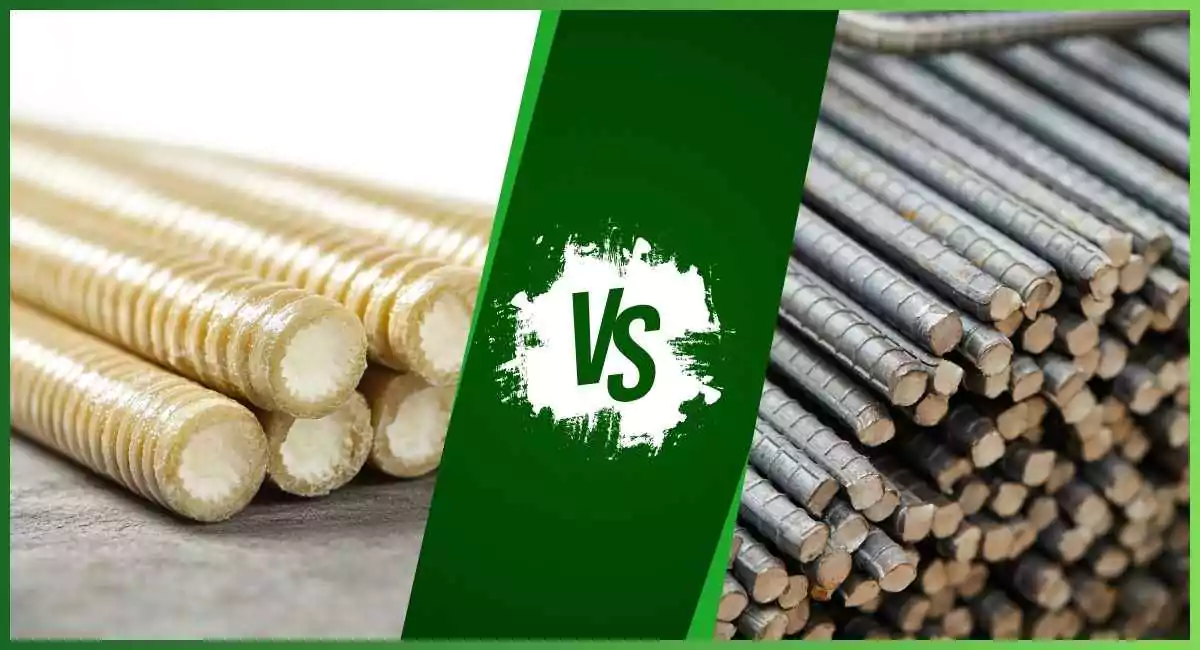
Corrosion-Resistant Steel vs GFRP Rebar – Understanding the Two Materials
When it comes to reinforcing concrete for long-term durability, corrosion-resistant steel and GFRP rebar are often compared because both aim to solve the same issue – corrosion. Traditional steel rusts over time, weakening concrete structures. But these two alternatives approach the problem very differently, which directly affects how they perform in the long run.
Corrosion-resistant steel is still steel at its core, but with added protection. This protection may come from epoxy coatings, galvanization, or alloying elements in stainless steel. These measures slow down corrosion and can significantly extend the life of a structure when exposure conditions are moderate. GFRP rebars, in contrast, contains no metal at all. Made from glass fibers embedded in a polymer resin, it is inherently immune to rust. This basic difference shapes most of its long-term advantages and limitations.
Long-Term Resistance to Corrosion
One of the biggest factors in long-term performance is how the reinforcement behaves when exposed to moisture, salts, and chemicals. Corrosion-resistant steel performs well initially, but its protection depends on coatings or material quality remaining intact. Over years of service, small cracks, abrasion, or damage during installation can expose the steel beneath. Once that happens, corrosion can slowly begin, leading to cracking and deterioration of the surrounding concrete.
GFRP rebar does not face this issue. Since it does not corrode, it does not expand inside the concrete or cause internal cracking. In aggressive environments such as coastal regions, marine structures, parking decks, and wastewater facilities, it offers a clear long-term durability advantage.
Structural Behaviour Over Time
Structural performance is about how materials behave throughout their lifespan. Steel is valued for its ductility, allowing it to deform before failure. This feature is beneficial in dynamic loading and seismic conditions, and it has made steel a familiar choice for designers for decades.
GFRP rebar behaves differently. It offers very high tensile strength but lower stiffness than steel. This means deflection and crack widths must be carefully controlled through proper design. However, when designed correctly, GFRP-reinforced structures perform consistently over time without the gradual strength loss that corrosion introduces in steel-reinforced concrete. GFRP’s performance does not degrade due to environmental exposure, making its long-term behaviour more predictable in corrosive settings.
Maintenance and Service Life
Over the decades, maintenance often becomes the true cost driver of infrastructure. Structures reinforced with corrosion-resistant steel typically still require inspections, patch repairs, and protective treatments as they age, especially in harsh environments. While these steels extend service life compared to conventional reinforcement, they do not eliminate corrosion-related intervention.
GFRP-reinforced structures significantly reduce this burden. With no risk of rust-induced cracking or spalling, the concrete remains more stable, repair cycles are extended, and lifecycle maintenance costs are substantially lower. For owners and operators, this translates to fewer disruptions and greater long-term value.
Fire and Temperature Considerations
Fire performance is an important design factor, particularly in buildings. Steel maintains structural integrity at higher temperatures for longer durations, though it does lose strength as temperatures rise. GFRP rebar contains a polymer matrix, which can be affected by high heat. In applications where fire resistance is critical, appropriate fire-protection measures must be incorporated at the design stage. This is not a limitation, but a design consideration, one that can be addressed through modern codes and protective detailing.
Cost Over the Life of the Structure
Upfront cost does not always reflect long-term value.
Corrosion-resistant steel often appears more economical initially, particularly epoxy-coated or galvanized options. For projects with low to moderate exposure, this can seem attractive. However, in environments where corrosion risk is high, GFRP rebar frequently proves more cost-effective over the structure’s lifespan. Besides having a low initial cost, it also boasts reduced maintenance, fewer repairs, and longer service intervals. When lifecycle costs are considered rather than just material costs, GFRP consistently demonstrates strong long-term economic performance.
There is no single reinforcement solution that fits every application. However, when long-term durability, minimal maintenance, and resistance to aggressive environments are priorities, GFRP rebar offers a clear advantage.
By completely removing corrosion from the equation, GFRP shifts the focus from repair and protection to performance and longevity. For infrastructure and structures designed to endure for generations, especially in harsh conditions, it is not just an alternative to steel, but a smarter long-term investment.
After all, the best material is not the one that looks good on paper today, but the one that continues to perform decades into the future.