
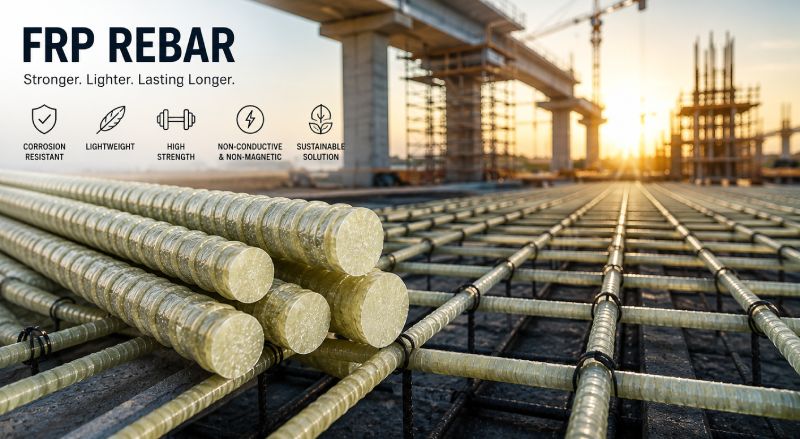
At any construction site, you’ll see steel reinforcing bars embedded in concrete. For decades, that’s been the norm. But today, a new material is stepping in with a compelling promise: Fiber-Reinforced Polymer (FRP) rebar, which is a smarter, more durable alternative built for modern infrastructure.
What is FRP Rebar?
FRP rebar is a composite reinforcement material made by combining strong fibers with a polymer resin. Instead of metal, it uses engineered fibers to deliver strength. And GFRP is the most widely used due to its balance of cost and performance.
How is it Different from Steel?
The biggest difference is simple. FRP doesn’t corrode. Whereas, steel, when exposed to moisture, salts, or chemicals, rusts and expands up to 6-7 times its size, also causing internal cracking in concrete. This leads to a global problem since 40%+ of infrastructure damage is linked to corrosion, and repair costs exceed $2.5 trillion annually. FRP rebar eliminates this issue, making structures more durable over time.
Key Benefits of FRP Rebar
1. Corrosion Resistance
FRP is non-metallic, so it won’t rust, even in coastal environments, chemical plants, and water treatment facilities. This can extend a structure’s lifespan by 2-3 times compared to steel-reinforced concrete.
2. High Strength-to-Weight Ratio
FRP rebar offers up to 2x the tensile strength of steel and about 70-75% lighter weight. This makes handling, transport, and installation faster and more efficient.
3. Non-Conductive & Non-Magnetic
Unlike steel, FRP doesn’t conduct electricity and doesn’t interfere with electromagnetic signals. This makes it ideal for hospitals and MRI rooms, rail and metro systems, and power and telecom infrastructure.
4. Sustainability Benefits
Construction contributes nearly 39% of global carbon emissions, and steel plays a major role in that.
FRP rebar helps by:
- Reducing maintenance and replacement cycles
- Lowering lifecycle emissions
- Cutting lifecycle costs by 20–25% in many cases
FRP Applications
The global FRP rebar market is growing rapidly, with a projected CAGR of 9–12%. It’s increasingly used in:
- Bridges and highways
- Marine and coastal structures
- Tunnels and metros
- Industrial flooring
- Water and sewage systems
Countries investing heavily in infrastructure, like India, are also actively beginning to adopt FRP for its long-term value.
FRP rebar represents a shift in how we think about construction and addresses one of the biggest issues in infrastructure: corrosion, while offering strength, efficiency, and sustainability. As cities grow and demands increase, materials like FRP are becoming essential to building the future.