
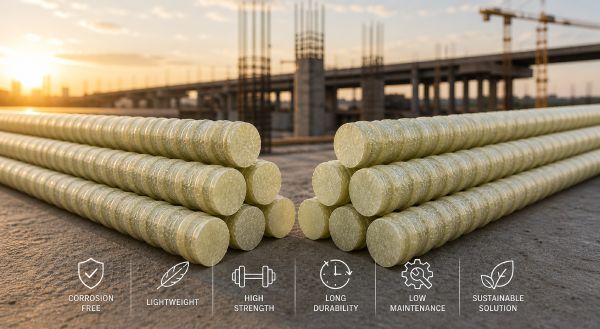
If you’ve come across the terms FRP and GFRP in construction conversations, it’s easy to assume they’re competing materials. But that’s not quite accurate. FRP (Fiber-Reinforced Polymer) is actually an umbrella category, a family of materials reinforced with different types of fibers. And these include GFRP. GFRP (Glass Fiber Reinforced Polymer) is simply one member of this family, made specifically using glass fibers.
Why FRP Rebar is Gaining Popularity
Across all its variants, FRP rebar is gaining traction for one major reason: it solves the problem of corrosion. Traditional steel reinforcement, while strong, has a critical flaw. When exposed to moisture and environmental elements, it rusts. This rust expands, up to 6-7 times its original volume, creating internal pressure that cracks concrete from within.
The impact is massive:
- Over 40% of global infrastructure damage is linked to corrosion
- Repair and maintenance costs exceed $2.5 trillion annually
FRP rebar eliminates this issue entirely. It doesn’t rust, doesn’t expand, and significantly improves the long-term durability of structures. That alone makes it a compelling alternative to steel in modern construction.
Where GFRP Stands Out
Within the FRP family, GFRP has emerged as the most commonly used option, and for good reason.
1. The Right Balance of Cost and Performance
GFRP strikes the ideal balance. It delivers strong performance without pushing budgets beyond practicality, making it suitable for large-scale, real-world applications.
2. Strength with Efficiency
GFRP rebar offers:
- Up to 2x the tensile strength of steel
- Around 70-75% less weight
This combination makes it not only strong but also easier to transport, handle, and install. Reduced weight translates to faster execution and lower labor effort on-site.
3. Proven and Scalable
Unlike newer materials that are still being tested in niche applications, GFRP is already widely used across industries, including:
- Bridges and highways
- Coastal and marine infrastructure
- Water treatment plants
- Urban construction projects
With the global FRP rebar market growing at a 9-12% CAGR, GFRP continues to lead adoption due to its practicality and reliability. GFRP stands out as the most practical and scalable solution. It delivers the key benefits of FRP, which are strength, efficiency, and longevity, without the high costs or limited availability of other variants.
So, which is better? For most real-world construction needs, GFRP isn’t just part of the FRP family; it’s the one leading the way.