
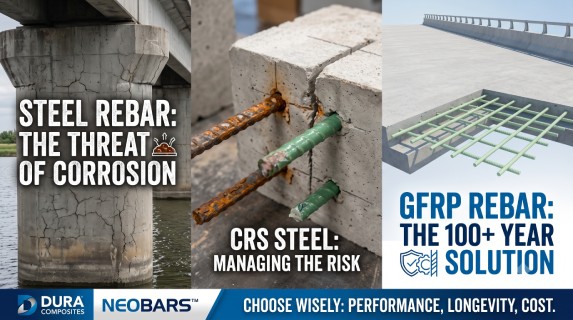
Choosing between steel, CRS steel, and GFRP rebar depends on the environment, expected durability, and long-term maintenance requirements of the project. While steel remains suitable for low-risk applications and CRS offers improved corrosion resistance, GFRP provides the best long-term performance by eliminating rust altogether while reducing lifecycle costs.
Picking the right reinforcement material is one of the biggest decisions in any infrastructure project. It affects performance, upkeep costs, and how long the structure lasts.
Which is Better Steel vs CRS Steel vs GFRP Rebar for Infrastructure Projects
The Three Contenders: Steel, CRS Steel, and GFRP Rebar
Mild/carbon steel rebar has been used for over a century. It follows long-established standards and costs the least upfront. But it’s also the option with the least protection built in, with a tensile strength typically in the 550 MPa range.
Corrosion-Resistant Steel (CRS) includes galvanized, epoxy-coated, stainless, and low-carbon chromium versions. These were built to last longer in tough environments. But at the core, it’s still steel. Here, the protection comes from a coating or alloy, not a real fix. It’s a manipulated fix, not exactly a solution.
GFRP rebar, on the other hand, is made from glass fibers set in a polymer resin. It doesn’t just slow down corrosion but also removes the problem completely, since there’s no steel to rust in the first place. Moreover, it has higher tensile strength and lower weight, which means reduced installation and maintenance costs and efforts.
2. Cost: Initial vs. Lifecycle
- Steel – cheap and commonly used, but that’s where the advantage ends.
- CRS – higher cost than mild steel for only partial protection.
- GFRP rebar – economically viable and also much lighter than steel, cutting down transport and labour costs.
3. Application Fit
- Mild steel – still workable for dry, low-risk areas with no exposure to moisture or chlorides, but this is a shrinking category of use cases.
- CRS – an option for moderate exposure, or where a structure needs to flex under seismic stress.
- GFRP Rebar– the clear choice for bridges, marine structures, roads exposed to de-icing salt, water treatment plants, tunnels, and any place needing non-magnetic or non-conductive material, like MRI rooms or substations, where steel was never really built to last.
Many projects now mix materials, using GFRP bar wherever exposure is worst. As GFRP rebar costs continue to come down and familiarity grows, it keeps expanding into territory that steel and CRS used to hold by default.
Steel still has a place where corrosion isn’t a concern, and CRS can bridge the gap for moderate exposure. But wherever corrosion is a real threat – coastal areas, marine structures, salt-exposed roads- GFRP like NEOBARS(TM) by Dura Composites is becoming the default. It removes the risk instead of managing it, and it does so at a lower cost over the life of the structure.