
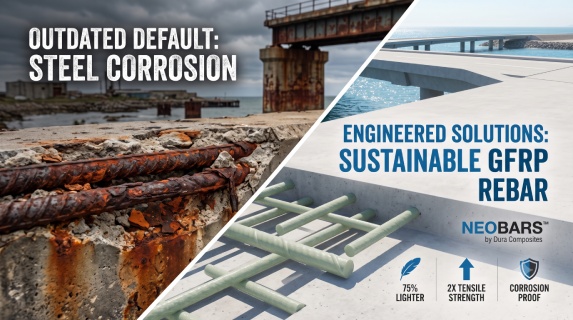
Engineers are increasingly switching from steel to GFRP rebar because it doesn’t corrode, is lightweight, and comes with high tensile strength. This contributes to better durability, quality, and sustainability of all kinds of infrastructure.
For decades now, steel has been the default choice for engineers. It’s the most commonly used, one that is also backed by years of design codes. But lately, many structural engineers are actively re-evaluating that default. Here are some reasons why there has been a switch from the standard concrete reinforcement to something more sustainable and feasible, such as NEOBARS(TM) by Dura Composites.
The Problem Steel Can’t Design Its Way Out Of
Steel rebar’s single biggest setback is corrosion. Corrosion is estimated to cost the global economy US$2.5 trillion annually, roughly 3.4% of global GDP, as per NACE International’s IMPACT study. The CORCON Institute of Corrosion estimates corrosion costs India about 4% of its GDP annually, amounting to around Rs 12 lakh crore a year in losses across public infrastructure, transportation, and industrial assets. With India’s roughly 7,500-kilometre coastline, coastal states are especially exposed to this damage.
When embedded steel rebar corrodes, the resulting rust can expand in volume by up to six times, creating internal pressure that cracks, spalls, and delaminates the surrounding concrete. This is known to be the leading cause of premature failure in reinforced concrete structures across the world, and that’s exactly why engineers designing for coastal roads, bridges, marine structures, and de-icing-salt-exposed parking structures are looking for better alternatives.
Why the Switch to GFRP is Beneficial
Glass Fiber Reinforced Polymer (GFRP) rebar, made from high-strength glass fibers embedded in a polymer resin matrix, was engineered to remove exactly the failure that steel is characterized by.
1. It doesn’t corrode
GFRP rebar contains no steel, so it’s immune to rust, chloride attack, and the acidic or alkaline degradation that erodes conventional bars. This isn’t just an improved solution, but it also eliminates the primary driver of concrete deterioration.
2. It’s also exceptionally lighter
At roughly 1,900 kg/m³ versus steel’s 7,850 kg/m³, GFRP is about 75% lighter, often described as “4x lighter” in practice. That translates directly into lower transport costs, faster and safer handling on site, and less labour cost and effort.
3. It also comes with higher tensile strength
GFRP rebar typically delivers a tensile strength of 1,000 MPa or higher, roughly two times that of standard Grade 60 steel (approximately 500 MPa). This makes it desirable for a range of infrastructure projects.
4. It’s non-conductive and non-magnetic
This makes it the specified material of choice for MRI rooms, substations, and other electromagnetically sensitive facilities, an application where steel is simply not an option.
Why the Switch Is Accelerating Now
Engineers aren’t abandoning steel because it’s a bad material. They’re specifying GFRP where steel’s one unavoidable weakness, corrosion, would otherwise dictate the entire maintenance budget of a structure over its service life. For coastal roads, bridges, water treatment plants, and marine works, that calculation is increasingly landing in GFRP’s favour. The sustainability benefits also add further weight in their favour over the outdated default, steel rebars.