
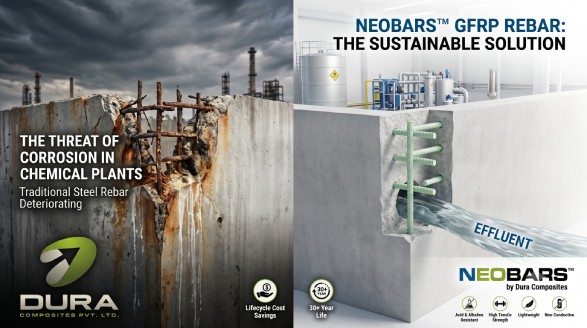
Chemical processing plants expose structures to some of the toughest conditions imaginable. Acidic spills, alkaline runoff, chloride exposure, and constant humidity all speed up the deterioration of traditional reinforcement. Even epoxy-coated steel rebar can eventually corrode if it is subjected to continuous chemical attack.
Once the process of corrosion begins, it tends to spread rapidly through concrete, weakening the foundational structure and reducing the overall lifespan of a plant or facility. A simple fix to avoid these problems is GFRP (Glass Fiber Reinforced Polymer) rebar.
Why Corrosion Is a Hindrance
In an industrial building, reinforcement doesn’t typically fail because it can’t carry the load anymore. Instead, it fails due to corrosion. Chemical processing plants are highly prone to the problem of corrosion because they are constantly exposed to Sulfuric acid, chlorides, and industrial effluents, which attack the steel from all directions. Additionally, controlling the extent of the deterioration involves regular inspections, expensive repair work, and disruptive full shutdowns.
However, a GFRP rebar cannot oxidise or rust. This feature alone makes it a more reliable option for the long run. For plant owners, that means fewer inspections solely due to the risk of corrosion, fewer emergency repairs, and a structure that holds its integrity even after direct contact with aggressive chemicals.
Where GFRP Should Be Used in Plant Construction
These are the applications where GFRP offers the greatest long-term benefit.
- Containment structures and secondary containment walls, which are expected to be exposed to direct chemical exposure.
- Trenches, sumps, and drainage channels that continuously carry corrosive industrial effluent.
- Foundations and slabs surrounding chemical storage tanks, where contaminated soil, moisture, and chemical vapours are constant factors.
- Flooring in acid-handling or electroplating areas, where chemical spills are part of normal day-to-day operations.
Strength Without the Weight
GFRP rebar combines a high tensile strength-to-weight ratio with a significantly lower weight than steel. That makes transportation, handling, and installation easier, particularly in congested areas where reinforcement has to be manoeuvred around existing equipment and services.
These benefits extend beyond strength. Because GFRP is non-conductive and non-magnetic, it can also be a practical choice in areas containing sensitive instrumentation, control systems, or electrical equipment commonly found in chemical processing plants.
Planning the Life-Cycle Cost
Steel generally costs less initially, but the purchase price is only one aspect of the total cost involved. Protective coatings, corrosion monitoring, structural repairs, and production downtime all add to the lifetime cost of steel-reinforced concrete. When those expenses are considered over the life of a project or structure of about 30 to 50 years, GFRP frequently proves to be the more economical solution in addition to its initial low cost.
In conclusion, chemical processing plants punish materials that can corrode. GFRP rebar removes corrosion from the list of things a structural engineer has to defend against, which is exactly why it’s becoming the default reinforcement choice for tanks, containment structures, and process areas across the industry. For facilities expected to operate reliably for decades, high-quality GFRP such as NEOBARS(TM) by Dura Composites serves as a reinforcement material chosen specifically for the demands of the environment.