
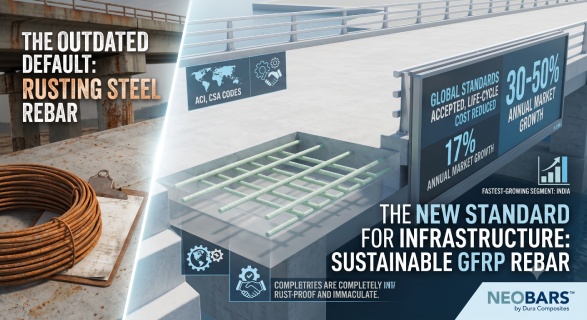
Yes, it is set to become a widely accepted reinforcement material for infrastructure globally and even in India. Players like DuraNeo are also actively building GFRP rebar manufacturing aligned with recognized international and Indian standards, such as NEOBARS(TM) by Dura Composites.
Every new construction material that enters the industry goes through a similar path. It is first met with doubt, then gains acceptance and becomes a niche material, gets wider codes and standards, and eventually becomes a mainstream material. GFRP, Glass Fibre Reinforced Polymers, is halfway through that path today, and is steadily being accepted by most of the industry. Its superiority in quality, strength, and economical cost is making it a top choice for construction today. Here is more on why it will become the standard soon.
The Case for “Yes”
The market is growing at an impressive rate, and the global GFRP rebar market is also expected to match the pace by growing from about $540 million in 2025 to $950 million by 2030. India is leading this growth, too. The Indian FRP rebar market is projected to grow at over 17% a year through 2030, among the fastest in the world.
And the rules are catching up, too. GFRP now has solid, recognized standards both internationally and in India. Over 2,000 bridges in the US have already been built using it. The lifetime cost math works in GFRP’s favour as well. Lifecycle costs can be 30-50% lower in corrosive environments, depending on project conditions. And with corrosion costing the world trillions of dollars a year, a large chunk of that is avoidable simply by choosing the right material.
Big players are already backing it. Saudi Aramco reportedly found GFRP could replace a meaningful share of its steel demand, and Indian GFRP rebar manufacturer like DuraNeo Neobars have started producing it locally.
Where GFRP Is Actually Winning
Instead of replacing steel everywhere at once, GFRP is becoming a superior go-to choice in specific high-risk categories:
- Marine structures and waterfronts, where saltwater is toughest on steel.
- Bridges and highways, the fastest-growing segment, thanks to durability needs.
- Metro tunnels and wastewater treatment plants, tied to major government projects.
- MRI rooms, substations, and similar facilities, where GFRP’s non-conductive, non-magnetic properties make it the only real option.
So, will GFRP rebar replace steel completely? The wave is certainly catching up. Especially in the areas where corrosion drives most of the long-term cost, GFRP is well on its way to becoming the standard. With India’s market growing at nearly 17% a year alongside massive infrastructure spending, wider usage is just a matter of time.