
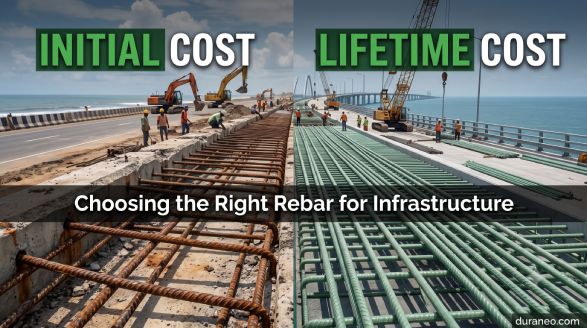
GFRP not only costs less than steel, but it also proves to be more economical over a structure’s lifespan due to reduced repair, maintenance, and replacement costs.
Material selection in infrastructure projects is often decided at the procurement stage, where price comparisons lean toward the cheaper option. But with GFRP rebar now priced competitively against steel, that first comparison is no longer the deciding factor. GFRP rebar is not only feasible at the outset but also feasible for years, and that is what makes a big difference for a project.
The Real Cost of Corrosion in India
Corrosion is a bigger problem in India than most people realise. A recent Nomura Research Institute report found that India loses close to ₹14 lakh crore every year to corrosion. That is about 4.3% of the country’s GDP, higher than the global average of 3.4%. Power, transport, and infrastructure are among the worst-hit sectors. Moreover, the Indian chapter of NACE International has estimated that around ₹22,600 crore of this loss comes from the infrastructure sector alone. With over 7,000 km of coastline, India’s infrastructure is especially exposed to salt-water corrosion, which definitely speeds up rebar damage in coastal and marine projects.
Why GFRP Steps in as a Saviour
Steel-reinforced concrete in corrosion-prone conditions often needs repair well before its life ends, including patchwork, recoating, or replacing damaged sections, each adding up to more cost. GFRP, on the other hand, doesn’t corrode, avoiding this cycle altogether. This, coupled with the initial competitive cost, serves as a solid advantage, especially in coastal, humid, or industrial sites where corrosion risk is highest.
Cost to Buy and Cost to Own
For infrastructure planners in India, the old idea of “pay more now to save later” doesn’t really apply to GFRP anymore. It’s cheaper to buy and maintain, making the choice less about trade-offs and more about what already makes financial sense.