
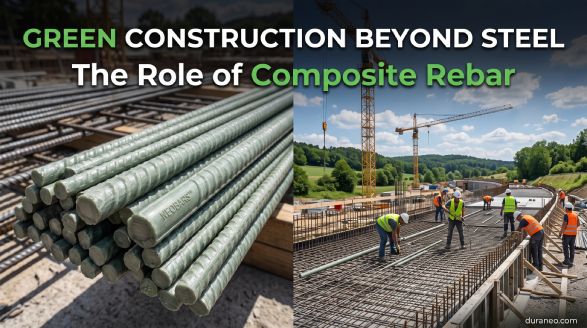
Composite rebar can support greener construction by reducing the carbon impact associated with steel production and reducing waste from corrosion-related repairs and replacements.
Sustainability in construction usually focuses on materials such as cement and steel, and for good reason. Together, they account for a large share of industrial emissions globally. Steel alone is responsible for roughly 7–8% of global CO2 emissions, with each tonne of steel produced generating close to two tonnes of carbon dioxide.
So, reducing the environmental impact of construction isn’t only about making buildings more energy efficient. It also means looking at the materials used to build them. This is where composite rebar can play a transformative role.
The Carbon Case Beyond Manufacturing
The environmental benefit of GFRP rebar is not only about how it is manufactured. It also depends on what it can help prevent over a structure’s lifespan and how it contributes to economic, labour, and other factors. In aggressive environments, steel-reinforced concrete can require repairs or replacement long before the structure reaches its intended service life. These repairs require new materials, energy, labour, and transportation.
GFRP does not corrode, and GFRP-reinforced structures are commonly designed for service lives of more than 100 years without corrosion-related deterioration. Because it requires fewer repairs and replacements, GFRP can reduce material use over a structure’s lifetime.
Lighter Material, Lower Logistics Footprint
GFRP is much lighter than steel. For comparable tensile capacity, it can weigh around a quarter as much. This makes transportation and handling easier, particularly for projects in remote or inaccessible locations. Some composite rebar manufacturers even report logistics savings of more than 30% on such projects. While the exact savings depend on the project, the lower weight can reduce the energy and emissions associated with transporting and handling reinforcement.
GFRP’s other properties also make it useful in newer types of infrastructure, including renewable energy foundations, electrical substations, and rail systems, where steel’s electrical or magnetic properties can create design challenges. In fact, research groups such as IIT Hyderabad have also explored GFRP-reinforced construction in the context of the UN’s Sustainable Development Goals.
As green building moves beyond just operations and enters the full life cycle of a structure, high-quality composite rebars such as NEOBARS(TM) by Dura Composites offer a more feasible way to reduce environmental impact.