
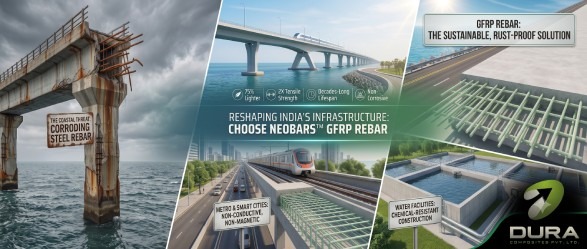
India is building at a rapid pace, one that only a few countries have matched. From highways and metro networks to coastal developments and smart cities, major projects are being delivered across the country at the same time.
But scaling up infrastructure projects also exposes weaknesses fast, and one of the most persistent challenges in Indian infrastructure has been corrosion. Factors like steel-reinforced concrete exposed to coastal air, monsoon cycles, and de-icing or chloride-heavy environments contribute to failure. Steel rebar begins to rust, the surrounding concrete spalls, and structures often require major repairs well before reaching their intended lifespan.
Composite reinforcement, particularly GFRP (Glass Fibre Reinforced Polymer) rebar, steps up here.
1. The Coastal Problem
With more than 7,500 kilometres of coastline, much of India’s infrastructure is exposed to harsh marine conditions. Ports, bridges, coastal roads, and seawalls are constantly exposed to salt-laden air, where chlorides accelerate the corrosion of steel reinforcement.
Once chlorides meet the embedded steel, corrosion begins. As rust expands, it cracks the surrounding concrete, leading to spalling, repairs, and a shorter service life. GFRP rebar avoids this problem entirely. Because it does not contain steel, it isn’t vulnerable to chloride-induced corrosion, making it a good option to build coastal bridges, jetties, seawalls, and other marine infrastructure.
2. Where GFRP is Already Being Used
As confidence in composite reinforcement continues to grow, GFRP rebar is finding its place across a wide range of infrastructure projects in India.
- Metro and rail systems, where its non-conductive and non-magnetic properties are beneficial for signalling equipment and electrical infrastructure.
- Coastal and marine structures, where long-term exposure to chlorides makes corrosion resistance a key design priority.
- Water and wastewater facilities, including wastewater treatment plants, where concrete structures are regularly in contact with aggressive chemicals.
- Smart city developments, where infrastructure is expected to remain in service for decades, make corrosion-resistant reinforcement a sensible long-term investment.
More Than A Materials Story
Performance isn’t the only reason GFRP is gaining ground in India. Manufacturing capacity within the country has expanded significantly, making the material more readily available within the country. This increased domestic production of GFRP has also helped narrow the cost gap between GFRP and corrosion-protected steel alternatives. In a market where infrastructure projects are closely evaluated on cost, the improved availability of this material gives contractors, consultants, and public agencies greater confidence in considering GFRP for new developments.
What This Means for Project Owners
For infrastructure that needs to perform for 50-100 years, durability is critical. When maintenance costs for bridges, coastal defences, and other critical assets are factored in, the math favours composite reinforcement.
India’s infrastructure ambitions aren’t slowing down, and many future projects will be built in environments that place even greater demands on construction materials. Coastal exposure, aggressive chemicals, and changing environmental conditions will remain important design considerations for decades to come. As domestic supply grows and codes become more structured, GFRP rebar, such as NEOBARS(TM) by Dura Composites, is positioned to be one of the defining materials in Indian infrastructure over the next decade.