
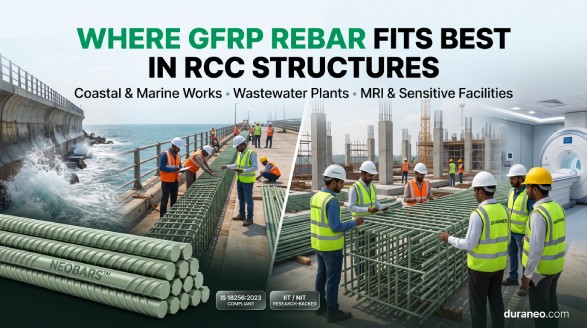
GFRP rebar steps up and performs exceptionally well in RCC structures that are exposed to moisture, chlorides, or electromagnetic sensitivity. This especially benefits coastal structures, water infrastructure, bridges, tunnels, and specialised facilities like MRI rooms, where steel’s corrosion or conductivity becomes a hindrance.
Steel is commonly used in reinforced concrete (RCC) structures, mainly due to its range of benefits and availability. But while it offers many advantages, the system’s main flaw becomes apparent when steel begins to corrode. Once that happens, concrete begins to crack and spall from the inside out.
That’s where GFRP proves to be superior –
1. Why GFRP Rebar Steps In
GFRP rebar stands out the most in coastal and marine structures. Seawalls, jetties, and buildings close to the ocean are constantly exposed to salt and moisture, which can cause steel reinforcement to corrode. GFRP rebar is naturally anti-corrosion, removing the major cause of structural deterioration. The same applies to water and wastewater treatment plants, where constant moisture and chemical exposure can damage steel over time.
Bridge decks and parking structures in regions that use de-icing salts are another strong application. This makes GFRP bar a superior alternative, especially where long-term durability is important. It is also ideal for environments where steel can interfere with electrical or magnetic equipment. Its non-conductive and non-magnetic quality can be used in MRI room foundations, transformer bases, and some rail infrastructure where steel reinforcement may create problems with equipment or signalling.
Tunnels, dams, and below-ground structures in aggressive soils are other potential applications. These structures can be difficult and expensive to inspect and repair once corrosion begins, so using a reinforcement material that does not corrode can offer a major advantage.
GFRP rebar is most valuable when the environment is a major concern, not just the structural load. Especially when moisture, chemicals, salt, or electromagnetic interference can affect long-term performance, GFRP bar can be the more sensible option. High-quality and trusted options such as NEOBARS(TM) by Dura Composites add another layer of durability.